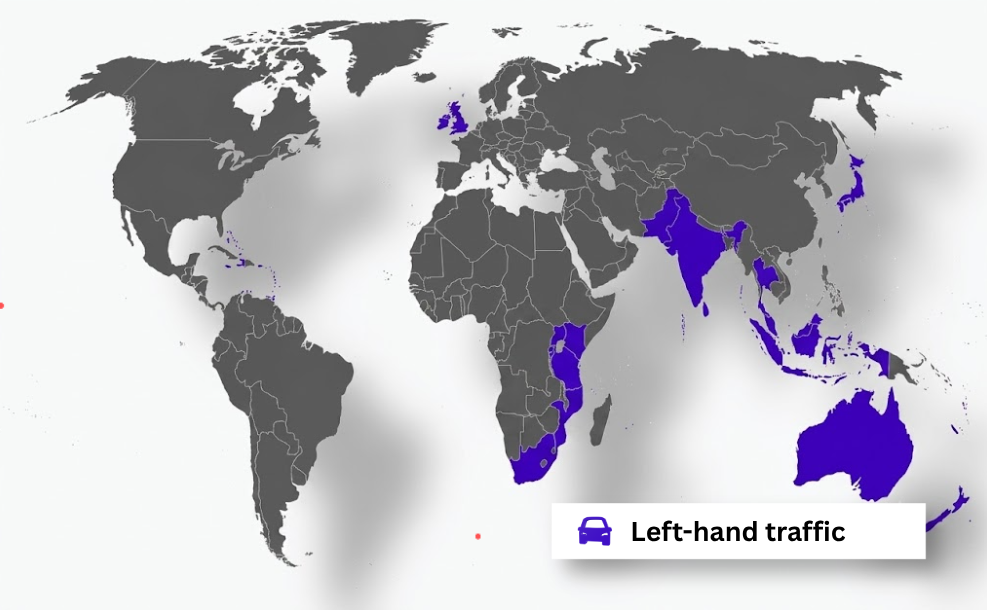
In more than 60 countries, people drive on the left, including popular travel destinations such as the United Kingdom, Australia, Thailand, and South Africa. For drivers from Germany renting a car, this means: right-hand drive, shifting gears with the left hand, and unfamiliar right-of-way rules at roundabouts.
Anyone getting behind the wheel for the first time in a country with left-hand traffic usually gets the hang of it surprisingly quickly, as long as the most important differences are clear beforehand. We’ll show you which countries drive on the left, what to look out for when booking a rental car, and how to safely get used to the new direction of travel.
In these countries, traffic drives on the left
Many countries that drive on the left were former British colonies and are now part of the Commonwealth. Within Europe, this applies to only a few, but popular, travel destinations.
- Europe: Great Britain and Northern Ireland, Ireland, Malta, Cyprus
- Africa: South Africa, Namibia, Kenya, Tanzania, Uganda, Mozambique, Zambia, Zimbabwe, Botswana, Malawi, Mauritius, Seychelles
- Asia: Thailand, India, Indonesia, Malaysia, Singapore, Japan, Sri Lanka, Nepal, Pakistan, Hong Kong, Macau, Bhutan, Brunei
- Oceania: Australia, New Zealand, Fiji, Papua New Guinea, Samoa, Tonga
- Caribbean & Central America: Jamaica, Barbados, the Bahamas, Trinidad and Tobago, Antigua and Barbuda, St. Lucia, Grenada, Dominica
- South America: Guyana, Suriname, as well as select routes in Bolivia and the Falkland Islands
For vacationers from Germany, the United Kingdom and Ireland are particularly relevant as nearby destinations, South Africa and Namibia as classic round-trip destinations, and Thailand, Australia, and New Zealand as popular long-haul destinations.
Booking a Rental Car in a Country with Left-Hand Traffic: What You Should Keep in Mind
A rental car in a country that drives on the left generally has a right-hand drive, meaning the steering wheel is on the right side. The clutch, brake, and accelerator are arranged in the same order as in the U.S., but you shift gears with your left hand instead of your right. In many vehicles, especially those from Asian manufacturers, the levers for the turn signals and windshield wipers are also reversed.
- Choose an automatic vehicle: Without having to shift gears with your left hand, you can focus fully on driving on the left side of the road, which makes the adjustment much easier.
- Choose a vehicle class you’re familiar with: A car that’s similar to the one you drive every day makes it easier to get used to driving there.
- Check your driver’s license and documents: In some countries outside the EU, an international driver’s license is required or at least recommended.
- Clarify insurance: An accident caused by your own mistake while driving on the left could, in some cases, jeopardize your insurance coverage; read more in our article on rental car insurance abroad.
- Be aware of age limits: As with any rental abroad, providers often have different age requirements; see our article on car rental age requirements.
Driving on the Left: The Most Important Rules
The basic rule is simple: You drive on the left side of the road and pass on the right. However, a few details differ significantly from right-hand traffic, as we know it from Germany.
- Clockwise roundabouts: Unlike in Germany, in countries with left-hand traffic, you drive clockwise in roundabouts, so you enter from the right.
- Right-of-way at intersections: Most countries with left-hand traffic do not have a general “right-before-left” rule; instead, “Give Way” signs govern right-of-way.
- Turning: When turning at intersections, move into the left lane early; this is the most common source of error for inexperienced drivers.
- Don’t drive too far to the left: Drivers accustomed to right-hand traffic tend to veer too far toward the left edge of the road in left-hand traffic. Keeping an eye on the vehicle ahead helps you stay in your lane.
- Fuel cap location: On vehicles built for right-hand traffic countries, the fuel cap is usually still on the right, but on many Japanese models, it’s on the left. A small arrow next to the fuel symbol on the dashboard indicates the correct side.
Here's How to Get Used to Your First Ride
For most travelers, the first few kilometers of driving on the left are the biggest adjustment of the entire trip. With a little preparation, it won’t be a source of stress.
- Before your first real drive, do a few practice laps in the rental car agency’s parking lot—it’s also a good place to practice parking on the left side.
- Plan your first route after picking up the car to be as quiet as possible, for example, on country roads instead of directly through a busy city center.
- In the first few days, consciously use the vehicle in front of you as a guide—this is especially helpful in roundabouts and when turning.
- Be especially attentive at intersections and roundabouts—that’s where most beginner mistakes happen when driving on the left.
- If you’re driving your own car into a country with left-hand traffic, adjust your headlights accordingly beforehand according to the owner’s manual so you don’t blind oncoming vehicles.
Conclusion: With good preparation, you can drive on the left side of the road with ease
For many travelers, driving on the left sounds more daunting at first than it actually is. To get off to a safe start:
If possible, choose an automatic vehicle so you can focus on the direction of travel. Practice driving a few laps in the airport parking lot before heading out into traffic. Pay special attention to staying in the correct lane, especially at intersections and in roundabouts. Make sure to clarify insurance and required driver’s license documents before your trip.
With this preparation, driving on the left will quickly become a minor issue, and you can focus on your destination.
Frequently Asked Questions About Driving on the Left
More than 60 countries and territories around the world drive on the left; many of them are former British colonies or members of the Commonwealth.
Within Europe, traffic drives on the left in the United Kingdom and Northern Ireland, Ireland, Malta, and Cyprus.
This is recommended because then you won’t have to get used to shifting gears with your left hand, and you can focus fully on the new direction of travel.
Im Kreisverkehr wird im Uhrzeigersinn gefahren, du fährst also von rechts in den Kreisverkehr ein statt wie in Deutschland von links.
That depends on the country. Within the EU, a German driver’s license is sufficient; outside the EU, an international driver’s license is required in many countries or at least recommended.
Intersections and roundabouts are considered particularly prone to errors, as drivers from countries with right-hand traffic unconsciously turn into the wrong lane there.
That depends on the vehicle. A small arrow next to the fuel tank icon on the dashboard display reliably indicates which side the fuel cap is on.